

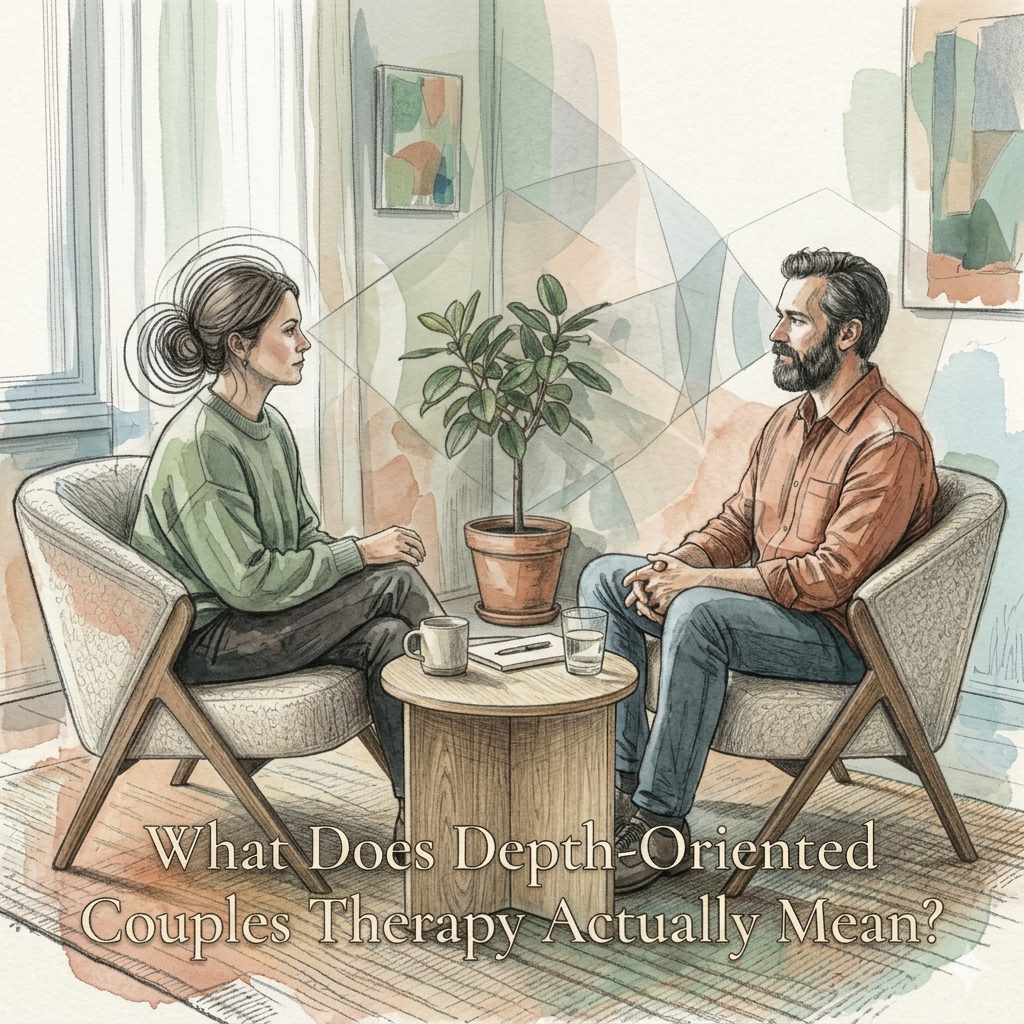
What Does Depth-Oriented Couples Therapy Actually Mean?
You may have seen the phrase "depth-oriented" on a therapist's website and wondered what it actually means in practice. It's not a modality. It's not a certification. And it's worth understanding before you choose a therapist.
Most couples therapy works on the surface. That's the problem.
Communication tools and conflict scripts are not useless. But for couples in real distress, the presenting problem is almost never what it appears to be. You're not really fighting about the dishes. The patterns driving your conflict have roots, and until those roots are addressed, the same fights will keep happening regardless of how many tools you've learned.
A peer-reviewed study in Contemporary Family Therapy (Doherty & Harris, 2024) found that couples therapy frequently fails not because couples don't try, but because the therapy itself stays on the surface. Depth-oriented work starts from a different premise: the relationship is the client, and the patterns between partners need to be understood at their emotional and relational roots.

7 Signs It’s Time for Couples Therapy
Every relationship goes through difficult seasons. Disagreements, stress, and growing pains are a normal part of sharing your life with another person. But sometimes the struggles that once felt manageable start to take on a weight that neither partner can carry alone.
If you've been wondering whether it might be time to talk to a professional, you're not alone — and the fact that you're even asking the question says something meaningful about how much you care. Here are seven signs that couples therapy could be a valuable next step for you and your partner.
Why Couples Therapy Fails (And What Actually Works Instead)
You finally convinced your partner to try therapy. You sat through sessions, maybe cried in the office, did the homework. And then... not much changed. If this sounds familiar, you're not alone, and it's not your fault.
Most couples therapy fails, not because couples don’t try, but because the therapy itself is often not designed for how relationships actually work.
Can couples therapy make things worse?
Yes, and research is starting to document how often it does.
A peer-reviewed study in Contemporary Family Therapy (Doherty & Harris, 2024) surveyed 270 couples therapy clients and found that 40% reported their therapist made at least one "relationship-undermining statement"; things like suggesting the relationship was beyond repair, that one partner had a personality disorder, or that divorce was the most realistic option. These statements were directly associated with worse outcomes and earlier dropout.
The researchers' conclusion: some therapists treating couples lack a relational framework and become pessimistic when the work gets hard. That's not a minor clinical error. That's a therapist inadvertently doing harm.